
• About

Henrik Christensen's Blog

~ Just another WordPress.com weblog

Henrik Christensen's Blog

Category Archives: robotics

Reflecting on 2020

31 Thursday Dec 2020

Posted by hichristensen in AMRON, robotics

≈ Leave a comment

The year 2020 is coming to an end and it is prudent to take time to reflect on the state of life, the universe, and everything on the final day of the year.

It has been an interesting year in many ways – some good news and some challenges.

Robotics

The world of robotics has generally done well. The pandemic has accelerated the adoption of e-commerce and home delivery. The pandemic has also made the need for tele-robotics much more obvious. We have seen new use-cases such as robot disinfection, which 12 months ago was considered exotic, and now it is obvious as a business case (not clear for how long).

Logistics

One of the clear winners during COVID was the need for more streamlined supply-chains. Early on in the pandemic, there was a massive shortage of toilet paper (of all things). Later a number of other things went missing for short periods of time. Home delivery from companies such as Walmart and Amazon became an everyday business.

Amazon used to have almost half of the e-commerce sector but the market share reduced to 1/3 during 2020, as more and more retails entities entered the space (Digital Commerce 360, 2020)

Service-based food delivery, such as Grubhub, and Doordash, was suddenly entirely normal just as Americans used to go out to restaurants now they were ordering food from their favorite restaurants for home delivery.

Obviously, supply chain was also a key item for delivery of vaccines to hospitals and to ensure that testing for COVID could maintain its efficiency. Multiple places had COVID testing with results returned in 15-20 hours. Some places also started to do wastewater testing for pooled testing (UCSD, 2020). Overall the biomedical sector saw significant growth.

The big push in e-commerce was bad news for local neighborhood stores. As an avid Yelp reviewer many of my regular places closed, and in many cases for good. 

Manufacturing

(source: Shutter Stock)

The economic downturn that started in late 2019 progressed into early 2020. The sector saw a reduction that was on par with the downturn during the 2009 recession (FRED, 2020). Many areas saw a relatively quick recovery. However, some areas such as automotive experienced a major downturn. Multiple automotive companies reported a 50% decline in revenue. Overall manufacturing is at the same level as it was in January 2016.

After the recession in 2009 some areas of the sector did a reset. As the recovery started back companies invested in new technology. This has resulted in China going from nowhere in robotics to being the largest market in the world, while Japan has seen limited growth over the last decade. For what sectors will we see a similar change in direction as we emerges from the 2020 downturn / pandemic?

Roadmap-2020

During 2020 we published the next version of the national robotics roadmap (ref). The roadmap brings together experts from industry and academia to consider growth opportunities and R&D needs to ensure continued economic growth. The roadmap points to major opportunities for automation as part of product customization, continued urbanization, and an ever aging society. Advances in new materials, sensors, machine learning, and user-interaction is paving the way for a new generation of robot applications across manufacturing, service, logistics, transportation, and healthcare. As we see a new administration early 2021 it will be interesting to see how/if science priorities are changing.

Economics

The stock market has seen tremendous growth over the last year despite the pandemic and the downturn during February and March. NASDAQ went up 41% during 2020, S&P 500 went up 15%, and Dow Jones Industrial Index 6%. Many people saw a big challenge in late March, but the market regained a lot of its momentum in the second half of the year.

Service, E-Commerce and new Energy did by far the best on the stock exchange, while cruise lines and oil companies fared the worst.

ROBO Global

As a co-founder of ROBO Global it was obvious to monitor the market closely, and pay special attention to the Exchange Traded Funds (ETF) sector.

ROBO Global has seen solid investments throughout 2020. The growth in logistics, healthcare, automation has generated a solid 43% YTD growth with across the various sectors.

ROBO was complemented by a healthcare investment during 2019. It would have been hard to find better timing. The HTEC fund has seen a 60% growth during 2020, as one would expect and the AUM is now well beyond $100M, and one would expect to see continued strong growth during
2021.

During 2020 a new fund focused on AI and Machine Learning (THNQ) was launched. The fund has seen a growth in value of 54% during the year. The second half of the year has been especially promising. During 2020 it was clearly shown how AI can be leveraged for optimization of logistics, quick drug discovery, real-estate optimization etc and it is clear that Artificial Intelligence and Machine Learning is a major part of our future society, so this is not surprising.

Science Community

Being a scientist / researcher during a pandemic is a different experience. We are used to spending a lot of time in meetings and at conferences. This year travel has been close to impossible. Consequently, meetings had to come to us. Doing remote meetings is not nearly as much fun and I am not convinced we have found the right model yet. We are by now used to pixelated video and sub-par audio, so volume went up and we accepted lower quality. During 2020 it became commonplace to see “strange video conference behavior” as part of commercials. It would have been difficult to imagine a year ago.

Still, science production is high. People are at home at lots of time spent in airplanes is not devoted to work in the home office. It is easy to set up 1:1 meetings between professors and students, but somethings are lost in video conferences. What will be the long-term impact on the community?

Taught two virtual classes during fall 2020. This was a lot more work that doing in person presentations and it is evident that the connection to students is very different from traditional classes. Presenting to 24 icons on a screen (where everyone has their video turned off) is much less motivating than discussing a subject with students in person. It takes a lot of work to prepare for these virtual classes and it will take time to get the model right.

An essential part of being part of the science community is social interaction, which has suffered during 2020. I think we all are looking forward to a time when we can socialize again.

R&D in a Post-COVID community?

An obvious question is how will the things evolve in a post-COVID world? It seems obvious that the educational system will slowly change to a model where engagement is life-long. For those of us in AI, Robotics, … the technology is changing at an exponential pace and there is a need for regular engagement rather than 3-year sprints. How will life-long education evolve? Could we imagine a subscription-based system where you sign up for 2-4 hours of continuing education for the rest of your life? Clearly, Coursera and Udacity have started a process in that direction, but for some domains, hands-on interaction is required a video lectures is not an obvious solution.

Others have engaged in problem-based education, where the skill and knowledge acquisition is driven by a life-long model to – learn to solve problems, learn to acquire knowledge and apply your skill set to address real-world problem. My alma mater – Aalborg University – is a leader in such an educational model and I see a need for many more to follow such a model. We do not need bit-sized education delivery, but an ability to educate people that can solve problems and acquire knowledge as the world evolves. This is especially important for areas with exponential growth.

Continuing engagement is also essential. Robotics Today (joint MIT/Stanford) and IFRR Colloquia are great examples of how the community has evolved to have weekly robotics seminars by world-class speakers broadcasted to everyone. Leading speakers could spend all their time traveling to universities to give one-hour tasks, this is a more effective mechanism for everyone to learn about state of the art, but clearly there is a need to complement with 1:1 engagement with leaders to ensure a broad model for engagement across the community.

Summary

The year 2020 has in many ways been the worst on record for most people. However, we have seen major technological progress, significant economic growth, and major changes in the academic enterprise. It will be interesting to see how we embrace these challenges and opportunities as we (hopefully) enter into a post-COVID era.

Wishing everyone a Happy New Year and all the best for 2021.
Robots for economic growth, improved quality of life and empowerment of people

17 Thursday Sep 2020

Posted by hichristensen in AI/ML, AMRON, robotics

≈ Leave a comment

The New 2020 Roadmap

Recently the robotics industry celebrated its 60-year anniversary. We have used robots for more than six decades to empower people to do things that are typically dirty, dull and/or dangerous. The industry has progressed significantly over the period from basic mechanical assist systems to fully autonomous cars, environmental monitoring and exploration of outer space. We have seen tremendous adoption of IT technology in our daily lives for a diverse set of support tasks. Through use of robots we are starting to see a new revolution, as we not only will have IT support from tablets, phones, computers but also systems that can physically interact with the world and assist with daily tasks, work, and leisure activities.

The “old” robot systems were largely mechanical support systems. Through the gradual availability of inexpensive computing, user interfaces, and sensors it is possible to build robot systems that were difficult to imagine before. The confluence of technologies is enabling a revolution in use and adoption of robot technologies for all aspects of daily life.

Thirteen years ago, the process to formulate a roadmap was initiated at the Robotics Science and Systems (RSS) conference in Atlanta. Through support from the Computing Community Consortium (CCC) a roadmap was produced by a group of 120 people from industry and academia. The roadmap was presented to the congressional caucus and government agencies by May 2009. This in turn resulted in the creation of the National Robotics Initiative (NRI), which has been an interagency effort led by the National Science Foundation. The NRI was launched 2011 and recently had its five-year anniversary. The roadmap has been updated 2013 and 2016 prior to this update.

Over the last few years we have seen tremendous progress on robot technology across manufacturing, healthcare applications, autonomous cars and unmanned aerial vehicles, but also major progress on core technologies such as sensors, communication systems, displays and basic computing. All this combined motivates an update of the roadmap. With the support of the Computing Community Consortium three workshops took place 11-12 September 2019 in Chicago, IL, 17-18 October 2019 in Los Angeles, CA and 15-16 November 2019 in Lowell, MA. The input from the workshops was coordinated and synthesized at a workshop in San Diego, CA February 2020. In total the workshops involved 79 people from industry, academia, and research institutes. The 2016 roadmap was reviewed, and progress was assessed as a basis for formulation of updates to the roadmap.

The roadmap document is a summary of the main societal opportunities identified, the associated challenges to deliver desired solutions and a presentation of efforts to be undertaken to ensure that US will continue to be a leader in robotics both in terms of research innovation, adoption of the latest technology, and adoption of appropriate policy frameworks that ensure that the technology is utilized in a responsible fashion.

Main Roadmap Findings

Over the last decade a tremendous growth in utilization of robots has been experienced. Manufacturing has in particular been impacted by the growth in collaborative robots. There is no longer a need for physical barriers between robots and humans on the factory floor. This reduces the cost of deploying robots. In the US the industrial robotics market has grown 10+% every year and the market has so far seen less than 10% penetration. We are thus far away for full automation of our factories. US is today using more robots than it has even done before.

A major growth area over the last decade has been in use of sensor technology to control robots. More digital cameras have been sold the last decade than ever before. When combined with advanced computing and machine learning methods it becomes possible to provide robust and more flexible control of robot systems.

A major limitation in the adoption of robot manipulation systems is lack of access to flexible gripping mechanisms that allow not only pick up but also dexterous manipulation of everyday objects. There is a need for new research on materials, integrated sensors and planning / control methods to allow us to get closer to the dexterity of a young child.

Not only manufacturing but also logistics is seeing major growth. E-commerce is seeing annual growth rates in excess of 40% with new methods such as Amazon Express, Uber Food, … these new commerce models all drive adoption of technology. Most recently we have seen UPS experiment with use of Unmanned Vehicles for last mile package delivery. For handling of the millions of different everyday objects there is a need of have robust manipulation and grasping technologies but also flexible delivery mechanisms using mobility platforms that may drive as fast as 30 mph inside warehouses. For these applications there is a need for new R&D in multi-robot coordination, robust computer vision for recognition and modeling and system level optimization.

Other professional services such as cleaning in offices and shops is slowly picking up, this is in particular true given the recent COVID-19 pandemic. The layout of stores is still very complex and difficult to handle for robots. Basic navigation methods are in place, but it is a major challenge to build systems that have robust long-term autonomy with no or minimal human intervention. Most of these professional systems still have poor interfaces for use by non-expert operators.

For the home market the big sales item has been vacuum and floor cleaners. Only now are we starting to see the introduction of home companion robots. This includes basic tasks such as delivery services for people with reduced mobility to educational support for children. A major wave of companion robots is about to enter the market. Almost all these systems have a rather limited set of tasks they can perform. If we are to provide adequate support for children to get true education support or for elderly people to live independently in their home there is a need for a leap in performance in terms of situational awareness, robustness and types of services offered.

A new generation of autonomous systems are also emerging for driving, flying, underwater and space usage. For autonomous driving it is important to recognize that human drivers have a performance of 100 million miles driven between fatal accidents. It is far from trivial to design autonomous systems that have a similar performance. For aerial systems the integration into civilian airspace is far from trivial but does offer a large number of opportunities to optimize airfreight, environmental monitoring, etc. For space exploration it is within reach to land on asteroids as they pass by earth or for sample retrieval from far away planets. For many of these tasks the core challenge is the flexible integration with human operators and collaborators.

The emergence of new industrial standards as for example seen with Industry 4.0 and the Industrial Internet facilitates access to cheap and pervasive communication mechanisms that allow for new architectures for distributed computing and intelligent systems. The Internet of Things movement will facilitate the introduction of increased intelligence and sensing into most robot systems and we will see a significant improvement in user experience. The design of these complex systems to be robust, scalable, and interoperable is far from trivial and there is a new for new methods for systems design and implementation from macroscopic to basic behavior.

As we see new systems introduced into our daily lives for domestic and professional use it is essential that we also consider the training of the workforce to ensure efficient utilization of these new technologies. The workforce training has to happen at all levels from K-12 over trade schools to our colleges. Such training cannot only be education at the college level. The training is not only for young people but must include the broader society. It is fundamental that these new technologies must be available to everyone.

Finally, there is a need to consider how we ensure that adequate policy frameworks are in place to allow US to be at the forefront of the design and deployment of these new technologies but it never be at the risk of safety for people in their homes and as part of their daily lives.

The Roadmap Document.

The roadmap document contains sections specific to societal drivers, mapping these drivers to main challenges to progress and the research needed to address these. Sections are also devoted to workforce development and legal, ethical and economic context of utilization of these technologies. Finally, a section discusses the value of access to major shared infrastructure to facilitate empirical research in robotics.

The Roadmap is available from http://www.hichristensen.com/pdf/roadmap-2020.pdf

The roadmap is formulated based on consultations and meeting with more than 80 people from across US and involving industry, academia and government institutions.

Robotics in a post-COVID world

09 Thursday Jul 2020

Posted by hichristensen in AMRON, robotics

≈ Leave a comment

Over the last few months, we have seen some major changes to society. The COVID-19 Virus, or the more accurate name for the infection Sars-CoV-2, has changed many things. It has already infected more than 10 million people with 3+ million of them in the US alone (by July 2020). The global statistics is available here.

The outbreak of the pandemic has had a number of effects. First of all, the healthcare system has been challenged. People have also been quarantined at home for extended periods of time. A large number of people have been laid off in USA (and globally). In addition, people have almost stopped traveling. An obvious question is how robotics and automation can assist in such a scenario.

In the healthcare sector, there are quite a few obvious use-cases. I) there is a need to increase the frequency of testing people to get a nuanced view of the degree of infection and the speed of infections (R0). Laboratory robots allow for faster processing of samples and return of answers to people. In a city such as San Diego with 1.4 million people, the target has been to test 5,200 people every day. At that rate we could test everyone once every 9 months. Six months into the pandemic (July 2020) it is still very difficult to get a test unless you have clear symptoms. Using this strategy, we will not get solid data anytime soon. Testing of 3/1000 daily is not a tall order. Laboratory robots can automate the testing and allow for more extensive testing. Many healthcare professionals have been exposed to COVID due to their front-line jobs. As such, there is a real need to use robots to acquire samples from patients, but also to enable a doctor at a distance to examine a patient and acquire basic information such as temperature, blood pressure, pulse, etc. Using tele-presence robots it is entirely possible today to increase the social distancing between patients and medical personnel for many of the daily tasks and through this reduce the risk of exposure for professionals. There are thus many good use-cases for medical robots beyond the well-known examples in surgery.

Manufacturing has declined significantly during COVID-19 (15+%), which is partly due to changes in market needs, but also due to the economic recession gained momentum after the start of the pandemic. Total industrial production is down by 20%. We have seen automotive sales go down by more than 50% for some companies (FRED estimates a decline of 55%). When isolated at home the traffic patterns change dramatically. Retail sales was down by 20+% in May 2020 and food/drink sales were down by 50% in May 2020. At the same time e-commerce continued to have significant growth. Sales of goods in the traditional retail sector was shifting from brick-and-mortar shops to the web. During the recession in 2009 countries such as China used the opportunity to change strategy. They decided to invest in robotics. Since 2009 they have had annual growth rates between 40-50% according to the industry statistics from IFR. Initially through joint venture partnerships with companies such as ABB, KUKA, and FANUC. In addition, through launch of new robotics companies such as Siasun, GSK, and Etun. Recently, Chinese companies have acquired foreign companies such as the MIDEA takeover of KUKA. It certainly put China on the map as a major player in robotics. In the US, the annual growth in robot adoption has been 12-14% but in comparison to China with annual growth numbers of 40+% the focus has shifted towards automation in Asia with India and Vietnam as new growth nations. Today 30% of all cars are manufactured in China, will this change in a post-COVID economy? Today there is about 1 robot for every 20 workers in highly automated industrial countries such as Korea, Japan, US, and Germany and we have still a long way to go to the lights out factories, as reported by IFR World Robotics. Nonetheless, it will be important to explore how robots will serve as a catalyst for future growth in manufacturing.

E-Commerce has seen tremendous growth over the last year. The growth is both in US with major companies such as Amazon and Walmart, but also by companies such as Alibaba, JD and Tmall. Already today Alibaba with Taobao is 50% larger than Amazon and is expected to continue to grow. Amazon has deployed more than 200,000 mobile platforms in their warehouses (the number is more like 300,000 by now). In addition, we are also seeing major progress on automated object pick-up / handling with companies such as Covariant.AI, Righthand Robotics and Berkshire Grey. As people desire a minimum of contact for items entering their house, we will see higher automation at distribution centers. There is significant interest in the last-mile problem of delivering from the truck to the front door in a domestic setting. The last mile could be solved using a traditional mobile platform as seen by Amazon’s Scout, another solution is clearly humanoid robots such as digit by Agility Robotics or traditional services such as May Mobility. Leaving the ground for a minute the drone market is obviously also being considered for last mile deliveries as seen by Amazon Prime Air or the experiments by UPS.

Cleaning is another important topic. This includes cleaning and disinfection beyond the hospital and the home. iRobot has seen a major uptick in sales of vacuum cleaners and floor scrubbers during the pandemic and shares are up 65% year to date. Additional cleaning is important to many households. In addition, we have started to see a flood of UV-C disinfection robots. Using UV-C lighting it is possible to achieve a high degree of disinfection with more than 99.9% of the virus eliminated when more than 10 microwatt / cm2 is radiated onto a surface. In many cases, a high-power source is used to allow even indirect illumination to kill the virus. There are already more than 50 companies worldwide pursuing this market. UVD robots from Denmark was an early entry into the market and have sold a significant number of units worldwide. Keenon from China has developed a robot that uses both UV-C lighting and a vaporizer to disinfect an area. The vapor will get to areas that may not be directly exposed by the UV-C light and provide redundant security. These two robots are merely examples of the vast number of new robots entering this market. The first place to see deployment of these UV-C robots was hospitals and care facilities. Recently, other high-traffic use-cases such as airports have also seen deployments. One would expect other use-cases to include hotels, malls, cruise ships, and eventually, they may enter your house as supercharged home cleaning robots. This is clearly a new robotics market that we considered unrealistic just a few months ago.

Transportation has changed dramatically. Over the last decade, we have seen a change from owning your vehicle of transportation to a model where mobility as a service is becoming increasingly common. Uber and Lyft started out with drive services. Eventually, this service was extended to include e-scooters and more recently Uber Eats and similar delivery services such as GrubHub. The second-largest expense for most households in the US is related to transportation, after mortgage or rent. Through use of transportation as a service, it is possible to reduce the mobility cost and optimize for the actual needs rather than paying up-front for an expected service, in addition, parking, etc is no longer a direct cost. Recently, trucking companies such as TuSimple, UPS, Cruise, Waymo … have all started to experiment with level-4 autonomy, where the car is in charge but can request assistance from the driver. This technology has a lot of promise for both e-commerce companies and logistics companies such as UPSP, UPS, FedEx, … Transportation is a sector where results may be seen even in the short-term.

COVID has exposed opportunities for robotics from cleaning/disinfection over e-commerce to manufacturing and transportation. Robots are primarily designed to empower to people do things better, in some cases in terms of accuracy in other cases as power or sensory extensions, and access. In the aftermath of the 2009 recession adoption of robotics grew significantly. In a post-COVID world we will see new behavior patterns for social interaction, cleaning, collaboration and delivery. There are thus many new opportunities for utilization of robot technology to enhance many different aspects of everyday life.

Why Invest in AI? All about the core technologies!

03 Monday Dec 2018

Posted by hichristensen in AI/ML, robotics

≈ Leave a comment

Tags

AIML

For some, investing in artificial intelligence feels like banking on the unknown. The concepts behind AI can range from sounding futuristic to downright fictional. And yet, when you break down AI and explore the core technologies that drive it, look at what they are delivering today, and consider what they are capable of delivering tomorrow, it’s suddenly quite easy to grasp how AI is changing the world around us. It is these facts that make investing in AI a not-to-be-missed investment opportunity.

Back in 2009, I was the main editor behind the formulation of US National Strategy for Robotics. At the time, as the strategy worked its way through Congress and to the White House, the conversation about why robotics mattered was an easy one. In the key areas of application—healthcare, defense, manufacturing, and logistics—it was simple to understand the physical applications of robotics in the real world. And yet, it was clear even then that robotics was somewhat limited in its application because, but its nature, robotics is restricted to interaction with the physical world.

AI is a completely different story.

Since 2009, our world has been fully transformed by one thing: Big data. AI enables us to make glean value from masses of information by finding patterns within the data to elevate the decision-making process, often exponentially. The result is a new wave of AI-driven decision-making that is adding value in nearly every aspect of our lives. AI is helping retailers make better customer recommendations, customize their offerings, and improve product design, delivery, and desirability. AI is helping medical professionals save lives by enabling them to diagnose and treat diseases in its earliest stages—often before symptoms occur—and compare millions of test results to quickly identify effective treatments. On Wall Street, AI is helping fund managers find the best opportunities, using data to quickly analyze everything from macroeconomic and statistical models to industry and geographical trends. AI is giving lawyers and judges the ability to sift through information at lightning speed to make better, more informed decisions. In the oil and gas industry, AI is making it possible to drill deeper, improve rig safety, and even identity system failures before they create mechanical failures that can threaten workers and the fragile environment.

What is spectacular is that this new level of decision-making would not be possible without the use of artificial intelligence and these core technologies that are driving faster, more effective memory processing, communication, and interactions:

  1. Big data analytics is used to examine enormous data sets to discover patterns, correlations, market trends, customer preferences, and other often hidden information to inform the decision-making process. Using predictive models, statistical algorithms, and what-if analyses, big data analytics helps companies identify new revenue opportunities, create more effective marketing, deliver better customer service, improve operational efficiencies, and drive competitive advantage.
  2. Cloud technologies enable companies to store unlimited amounts of data and balance workloads within that data. Even more, AI and the Cloud share a fascinating symbiotic loop: the Cloud serves as the primary source of information that feeds AI networks, and AI networks continuously feed the Cloud with even more data. Already a key driver of competitive advantage and a coveted differentiator, Cloud platforms support some of the most important foundations of AI, such as cloud computing, machine learning, language processing, and more.
  3. Cognitive computing came into public awareness when IBM’s Watson computer famously beat two human champions on Jeopardy! and claimed the $1 million first-place prize. It was a brilliant marketing campaign to bring awareness of the power of cognitive computing to the public and, even more importantly, to the leaders of industry. Today, cognitive computing is used to accelerate processes such as reasoning, natural language processing, speech recognition, object recognition, and dialog generation. According to research firm IDC, worldwide spending on cognitive and AI systems is expected to increase by more than 50% by 2021, taking total spending on cognitive computing from $12B in 2017 to $57.6B by 2021.
  4. Network & Security is more important than ever in this ager of cyber attacks and data breaches, resulting in estimated double-digit growth from 2018 to 2023, leading to global revenue of $193.76B by 2023. As businesses strive to protect the personal and financial information of their customers and, indeed, their own reputations and futures, they rely on AI to support identity and access management, encryption, governance, risk and compliance, unified threat management, and security information and event management. Encryption capabilities are in particularly high demand to protect information stored on consumer devices and to use that information securely in the Cloud.
  5. Semiconductors are a key component of today’s digital capabilities, enabling every computer and electronic device. While semiconductors have been around for decades, AI is driving new semiconductor designs and capabilities. Using the power of machine learning and deep learning, industry leaders are finding new ways to speed up performance and reduce power, process data as patterns rather than individual bits. This progress is the key to delivering everything from quantum computers to fully autonomous vehicles.

When we created the ROBO Global Robotics & Automation Index over 5 years ago, focusing on the broader spectrum made sense. It still does. But as the promise of AI has evolved into the new world reality of AI, it was clear that the time had come to create an index with a singular focus on AI. The result of our efforts is THNQ: an index that offers 100% pure-play exposure to companies that are investing in and delivering AI today—and changing the world as we know it. Every day, the deeper we dive into AI, the more opportunity we see.

Of course, choosing whether to invest in RAAI or AI is not a clear either/or decision. Investors who are keen to invest in the physical application of technology—warehousing, autonomous vehicles, consumer robotics—will find ROBO to be the best fit. And there is certainly plenty of exposure to AI within the ROBO index; the overlap between the two indexes is currently about 30%. For investors who are seeking pure exposure into the fast-growing world of AI that is using the power of computing to drive better decision-making, THNQ is a unique option that enhances that exposure by honing in on AI alone and positioning investors to reap the potential rewards.

Originally published at RoboGlobal

National Robotics Roadmap – Version 3

30 Friday Dec 2016

Posted by hichristensen in robotics

≈ Leave a comment

The first version of the National Robotics Roadmap was published 2009 with the support of CCC and later revised 2013. Just before the recent election a new version of the National Robotics Roadmap was published on November 7th.

The roadmap covers key applications drivers for use of robotics across manufacturing, services, healthcare, space and defense. Based on identified drivers the expected progress with research and development is predicted 5, 10 and 15 years into the future.

The revision of the roadmap included a re-organization of the document to have a strong separation of societal drivers and R&D needs. In addition, new sections were added to discuss educational needs, and ethical, legal and economic considerations. Utilization of new robotics technology will only be possible if we carefully consider preparation of the workforce to leverage this technology with education from K-12 through community colleges to universities. We are also seeing daily discussions about legal implications of robot technology from deployment of driverless cars on public roads to use of UAV in the National Airspace. Ethical considerations of use of robots in homes, with children, etc. are also essential to the future of robotics.

From an R&D point of view it was interesting to see that driverless vehicles and UAVs had progress faster than expected as applications. Supply chain use of robotics was also growing faster than expected. Machine learning is a technology that has gained tremendous popularity. Safe actuation, gripper technology, long-term autonomy and effective human-robot interaction are examples of areas that have progressed slower than expected.

You can read the full 2016 Roadmap here. The CCC also released a white paper earlier this year, titled Next Generation Robotics, which examines the past five years of the NRI and provides recommendations for the future.

Shared Autonomy – are we close?

12 Monday Sep 2016

Posted by hichristensen in robotics

≈ Leave a comment

We are at present seeing a lot of interest in autonomous systems. A lot of automotive companies are talking about autonomous cars or driver-less cars. GM and Google demonstrated early systems. Google started out with automation of regular cars and has also presented a concept system for a car without a steering wheel [URL]. Tesla has a model where the driver is expected to take over [URL] when the autopilot cannot provide a robust solution. The sharing of autonomy between well understood contexts – that are handled automatically and human intervention for challenge situation is a version of shared autonomy, where humans and robots collaborate to achieve a mission objective.

Tele-operation of robots has existed for a long-time. Much of the early work was carried out in the  handling of radioactive material, where direct contact by people is not an option. These systems were all purely tele-operated. This the same type of model we see applied to medical robots such as minimally invasive systems. The Intuitive Surgical System – Da Vinci [URL] is a great example of such a system. The objective is here minimization of trauma to the body.

For Aerospace Systems we have long know the auto-pilot which is a shared autonomy system. The pilots will typically handle take-off and landing, whereas cruise flight is handled by the auto-pilot. For Unmanned Aerial Vehicles (UAVs) the pilots / operators are sitting on the ground and operating vehicles that may be airborne for as long as 36 hours. We are seeing similar applications for smaller UAVs for commercial and entertainment tasks. New commercial applications include building inspection and mapping of construction sites [URL]. For entertainment companies such as DJI [URL] build robots that are radio controlled. We are slowly seeing small functions such as level keeping or automation tracking of skiers which are examples of shared autonomy. The systems are launched and an objective is specified (tracker me, or maintain level) which is performed autonomously.

One of the biggest challenges in design systems with shared autonomy is to provide the operator with adequate context to allow them to take over as appropriate. A great example of a system that does this in an industrial context is the company Aethon [URL] out of Pittsburgh. They provide delivery robots for hospitals and other institutions. The objective is an autonomous system, but when a robot gets caught in an unusual situation such as a trashcan in the middle of a hallway, the robot requests assistance from a call center. The operator uses the on-board sensors to understand the problem and drive the robot out of the situation. If you are in a car taking over control is more of a challenge when you are driving 55 mph down the highway. It takes time to understand the challenge and to take over, which challenges the design of such systems with automatic takeover. How do we provide the driver with adequate information to take over control of the car? Or is this an appropriate model for shared control?

As we explore the shared control of systems with some functions performed autonomously and others carried out by an operator it is essential to consider the fluency of human-robot interaction, to consider the cognitive aspects of systems and to ensure that engineers use these models as an integral part of their systems design.Over the next few years we will see tremendous progress on design of systems that off-load the operator but we will be challenged in doing this in a way that still allows the operator to intervene for challenge cases. So far few systems have managed to do this with a high degree of fluency. We need more research at the intersection of cognitive science, system engineering and robotics to fully leverage next generation systems with shared autonomy.

Chine is still a major growth engine

09 Tuesday Aug 2016

Posted by hichristensen in robotics

≈ 2 Comments

Over the last 4 years we have seen solid growth in robot sales worldwide. The biggest growth has been in China. Overall 70% of all robots are sold in China, Japan, Germany, South Korea and USA. 25% of all robots are sold in China. The growth does not seem to stop anytime soon. Why is that?

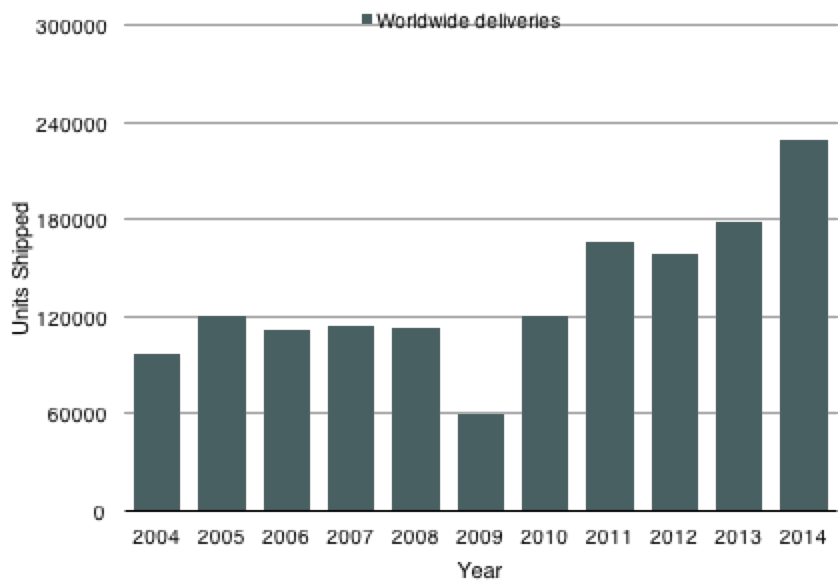
Over the last few years we have seen major growth also in USA, South Korea and Japan. The overall sales figures from the IFR World Robotics are shown below:

world-wide-sales

Worldwide robot deliveries over the last 10 years. The growth since 2009 is dramatic.

The CAGR since 2009 has been 17% and it is interesting that more than half of all robots sold are delivered to factories in Asia. The total value of the robot industrial market 2014 was $10B, and if integration is included the total value is close to $30B. This very much matches the general rule for cost breakdown – ~30% of an installed system is the actual robot, ~20% of the cost is related to other hardware such as the end-effector, fencing, and conveyors.

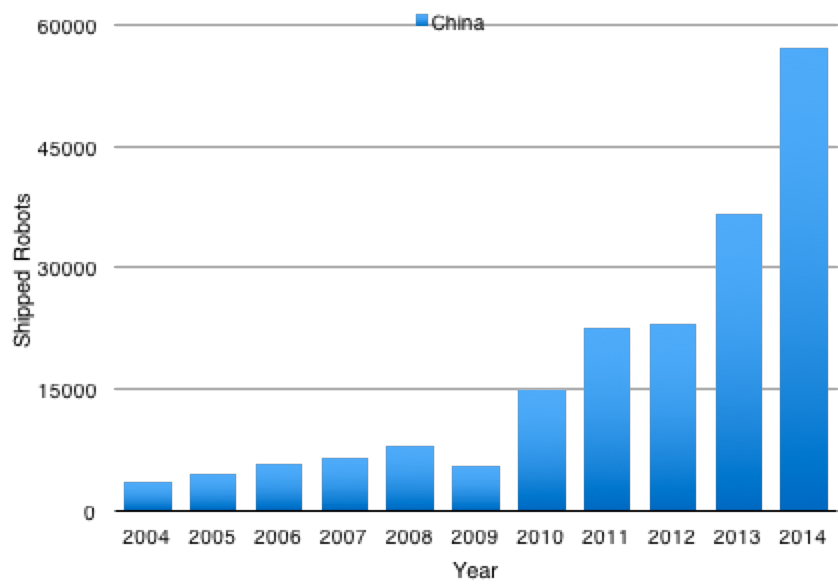
Sales in China has been particularly impressive with 50%+ annual growth that last 3-4 years. The growth has been very much motivated by a need to retain manufacturing in China. The hourly wages for manufacturing workers has gone up 350% over the last 10 years.

80% of the robots delivered were manufacturing by foreign companies or joint ventures in China. These companies experienced 49% year-year growth 2014-2015. The remaining 20% of robots delivered were made by Chinese companies. The annual growth (2014-2015) was 78% which is most impressive.

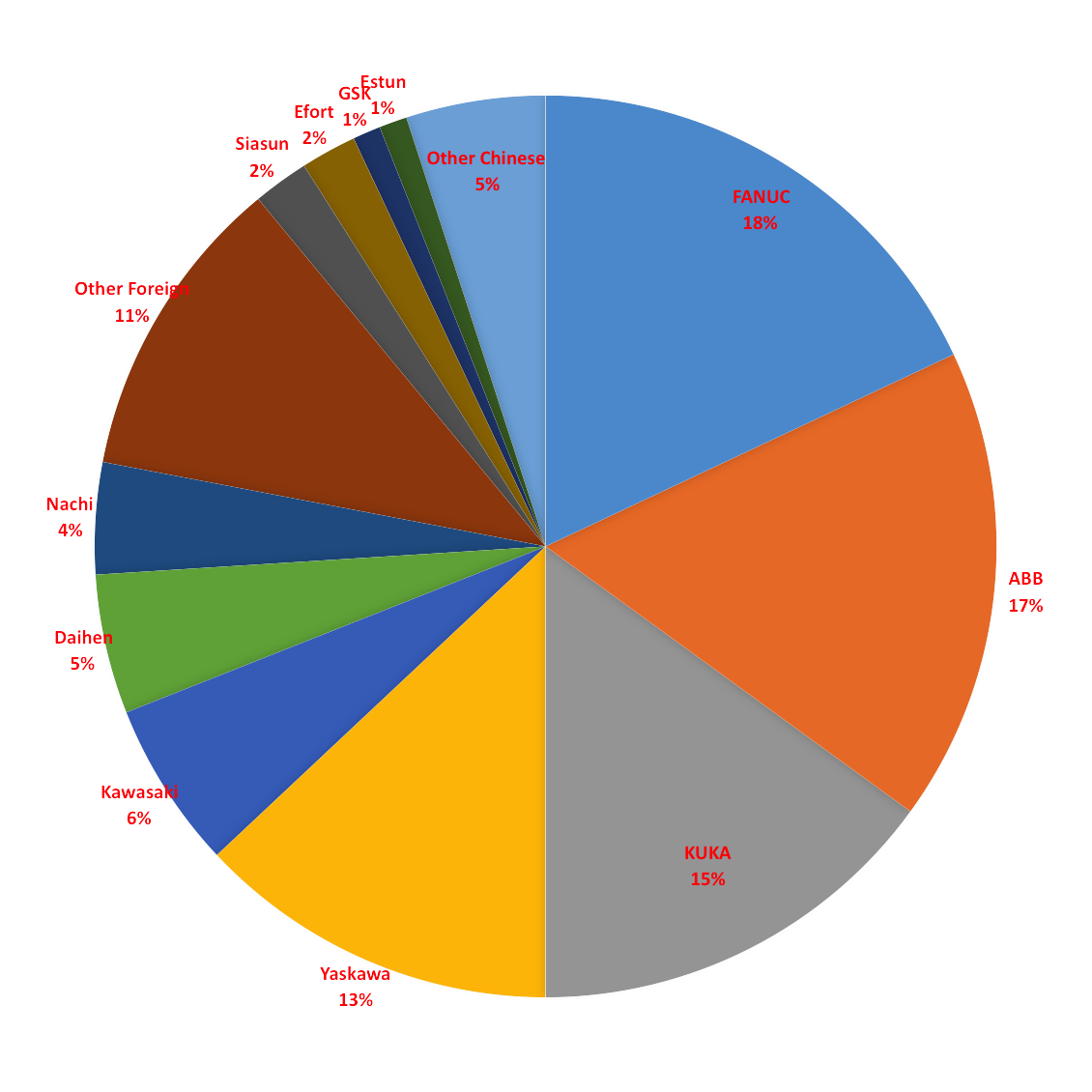
The division of market shares is shown below (for 2014). As expected the biggest company was FANUC, but closely followed by ABB, KUKA and Yaskawa. The biggest Chinese company was Siasun, that is emerging as the leader from the Chinese companies.

Already today more than 30% of all cars manufactured worldwide are produced in China. However, very few of these are sold outside China. First of all there is a major home market and in addition the industry is challenged by inconsistent quality.

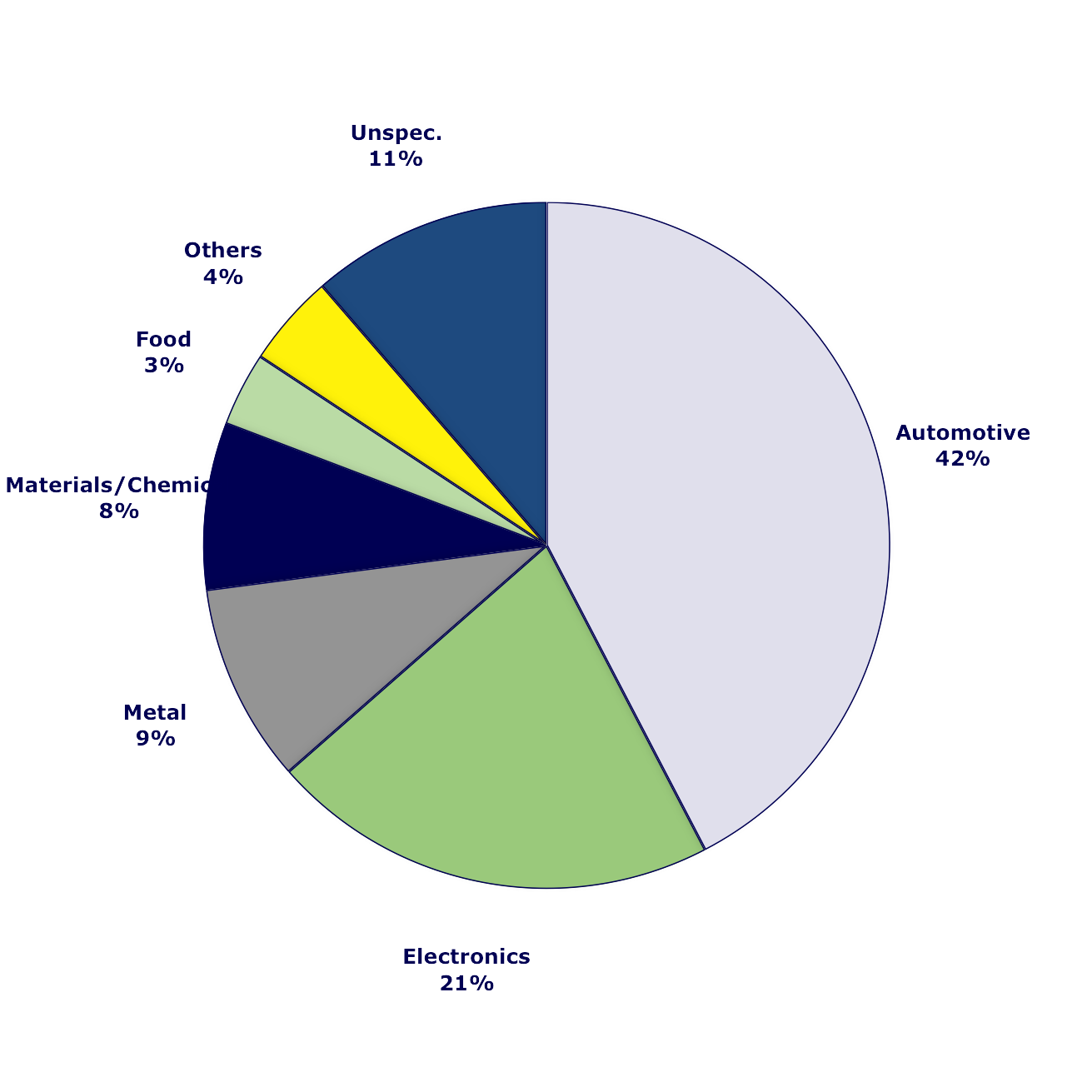
For robotics in general the main application area is still automotive, which takes up close to 42% of all robots sold. Electronics is number 2 and metal handling is 3rd. The fact that China has emerged as the largest producer of cars and also as a country with a need for automation to remain competitive points to a clear need for major growth in robot sales.

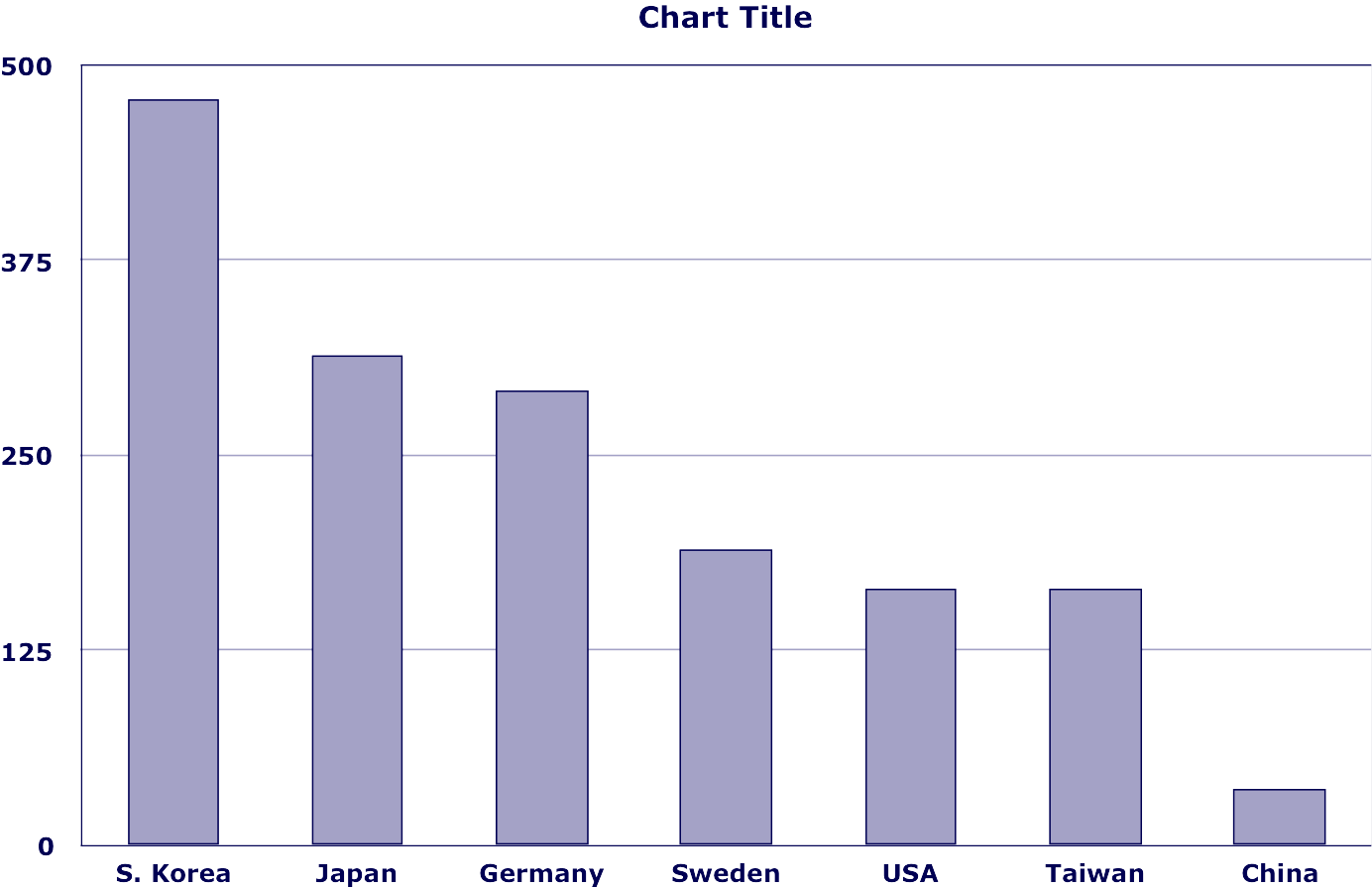
Often the maturity of a market is measured by the number of robots deployed for every 10,000 workers in an industry. Korea has emerged as a leader with almost 500 robots deployed / 10,000 workers. Japan is second and Germany third. The world average for manufacturing countries is 87 robots / 10,000 workers. For 2014 China had only ~40 robots / 10,000 workers. Consequently China would have to double its robot inventory to even have average utilization of robots.

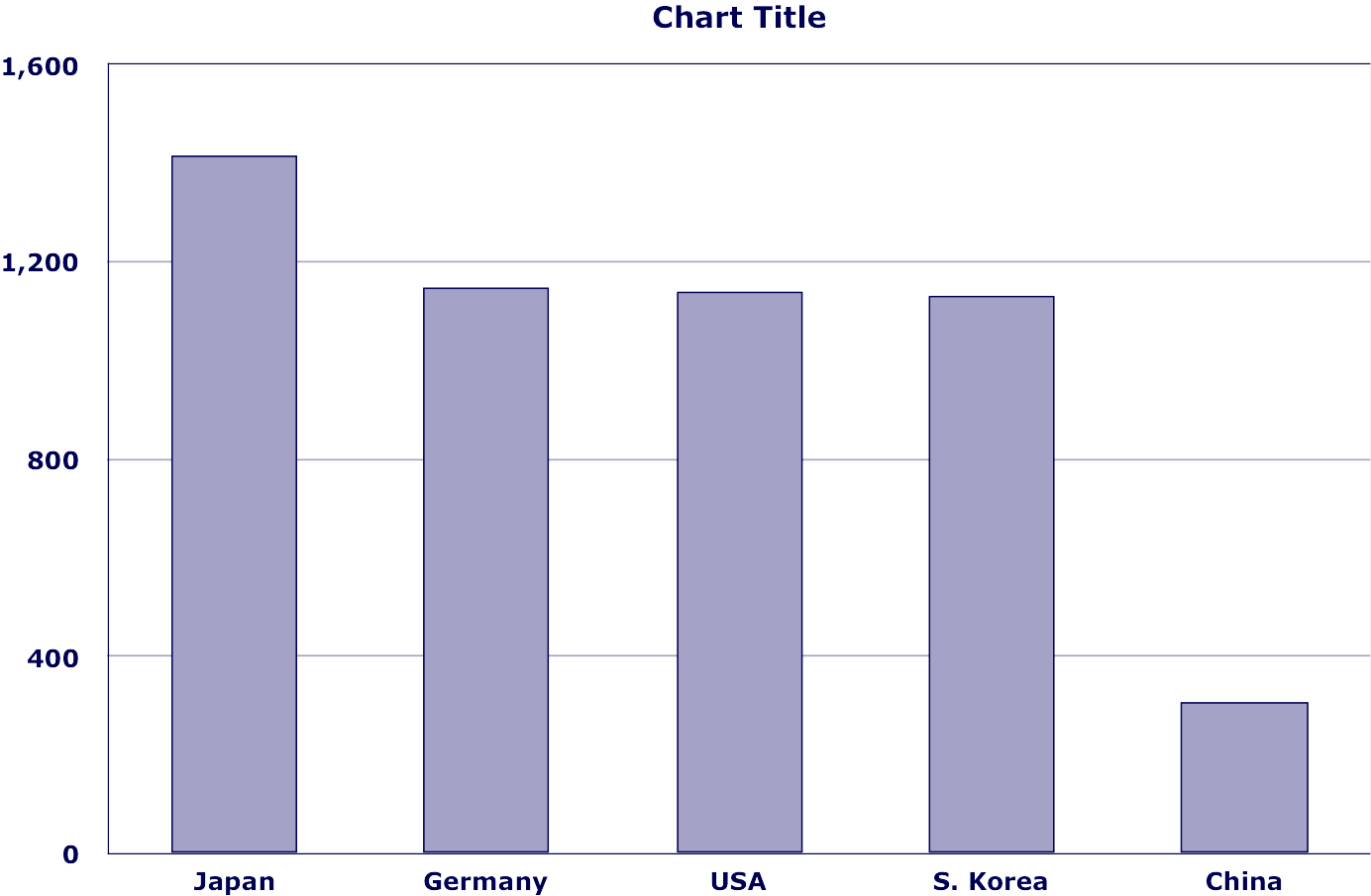
If we zoom in on the automotive industry then the average penetration is 1 robots / 10 workers. Japan is the leader  with use of lean manufacturing and a high degree of automation. Countries such as Germany, USA and S. Korea are all close to the expected 1/10. China on the other hand is closer to 1/30 as shown below.

Consequently, one would expect to see major growth for the automotive market too. Salaries are lower in China, but the real driver is really quality of the final product. The big driver is consistent quality to ensure that product manufactured at any time of the day or any day of the week have the same quality.

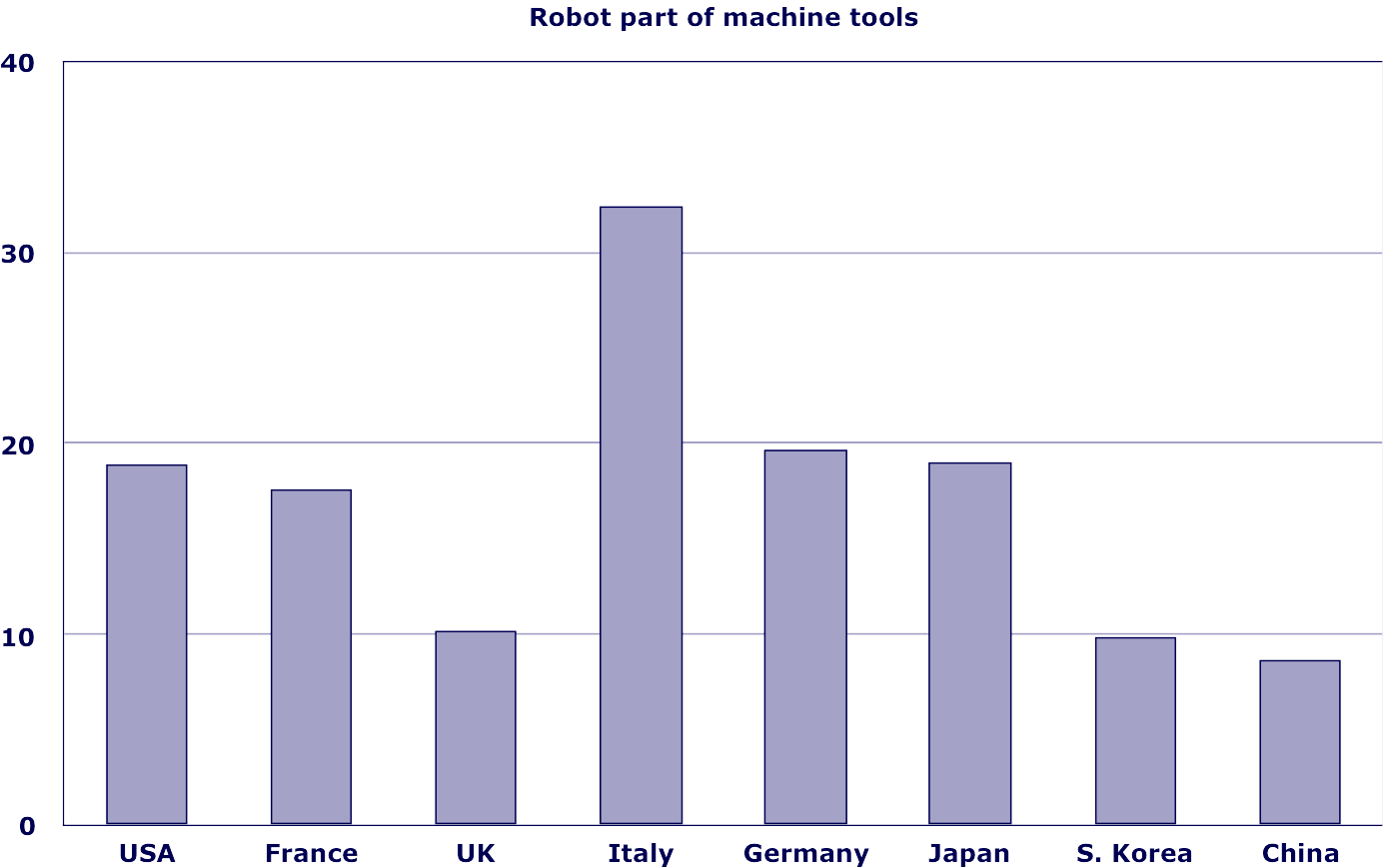
Frequently, the improvement in quality has been achieved through use of machine tools. They have a high stiffness and can generate high accuracy products with a high quality. One challenge for a factory that is laid out using machine tools is limited flexibility. It is difficult to change a factory line with a series of machine tools. In the automotive industry it is common to change the model at least annually and even with a common platform programming can be a major challenge. Consequently, we have seen an increased interest in utilization of robots as a replacement for machine tools. It is easier to change the end-effectors and industrial robots are designed for easy programming. Consequently, we are seeing a shift from machine tools to industrial robots. The general statistics for machine tools vs robots is shown below.

Again China is only at half in its utilization compares to major markets such as USA, Japan and Germany. Consequently there is no doubt we will continue to see major growth in China and slowly we will also see a strong presence of Chinese companies. In some cases these companies will emerge directly from China and in some cases these companies will emerge from foreign acquisitions such as the Midea acquisition of the majority share in KUKA AG.

Overall the robotics industry is expected to continue to see solid (~15-20% annual growth) but the major growth driver will without doubt continue to be China for the foreseeable future.

Note: Many of the numbers in the post were adopted from the IFR World Robotics Publication.

Robot Growth in Asia

04 Monday Jan 2016

Posted by hichristensen in robotics

≈ 2 Comments

Tags

robotics

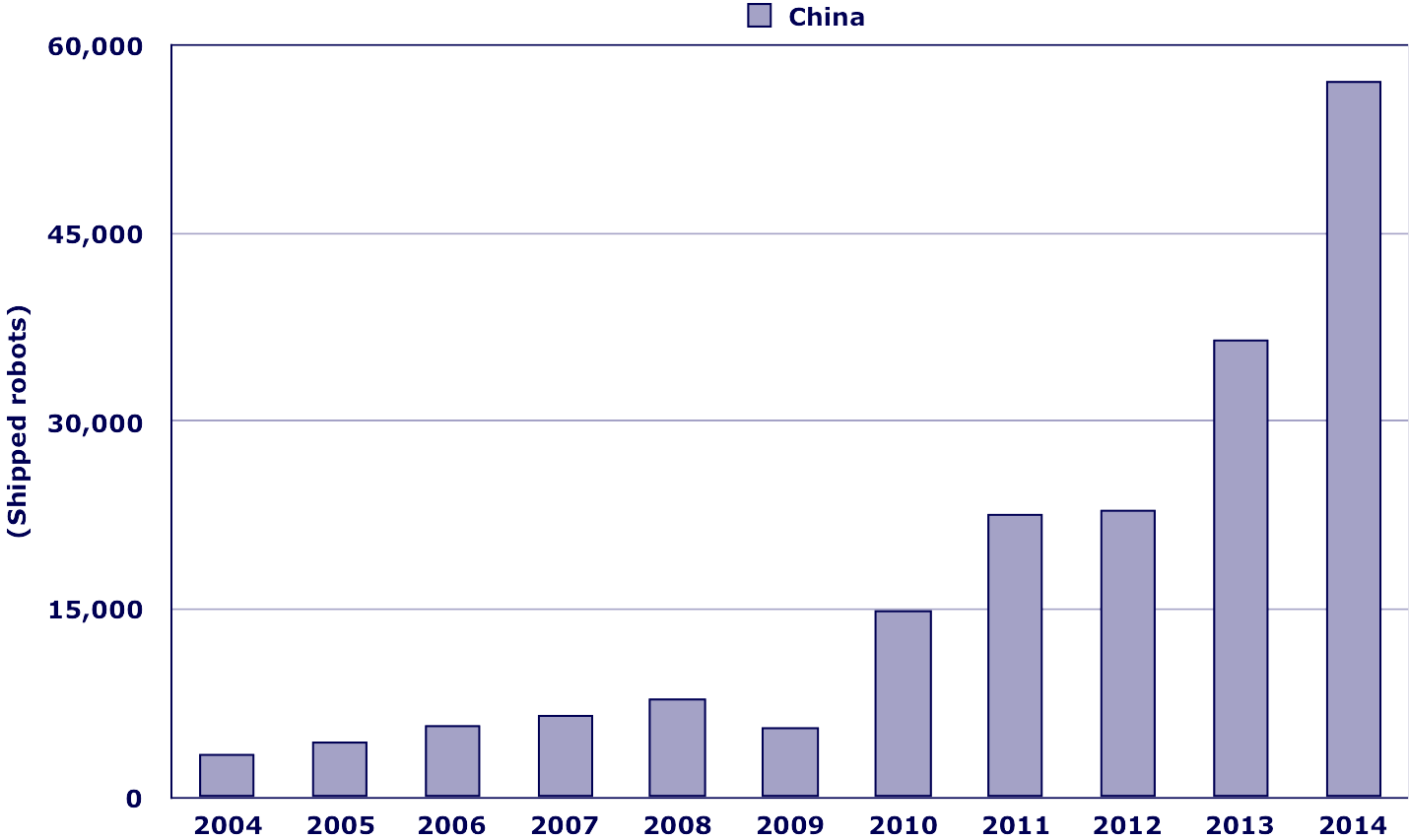
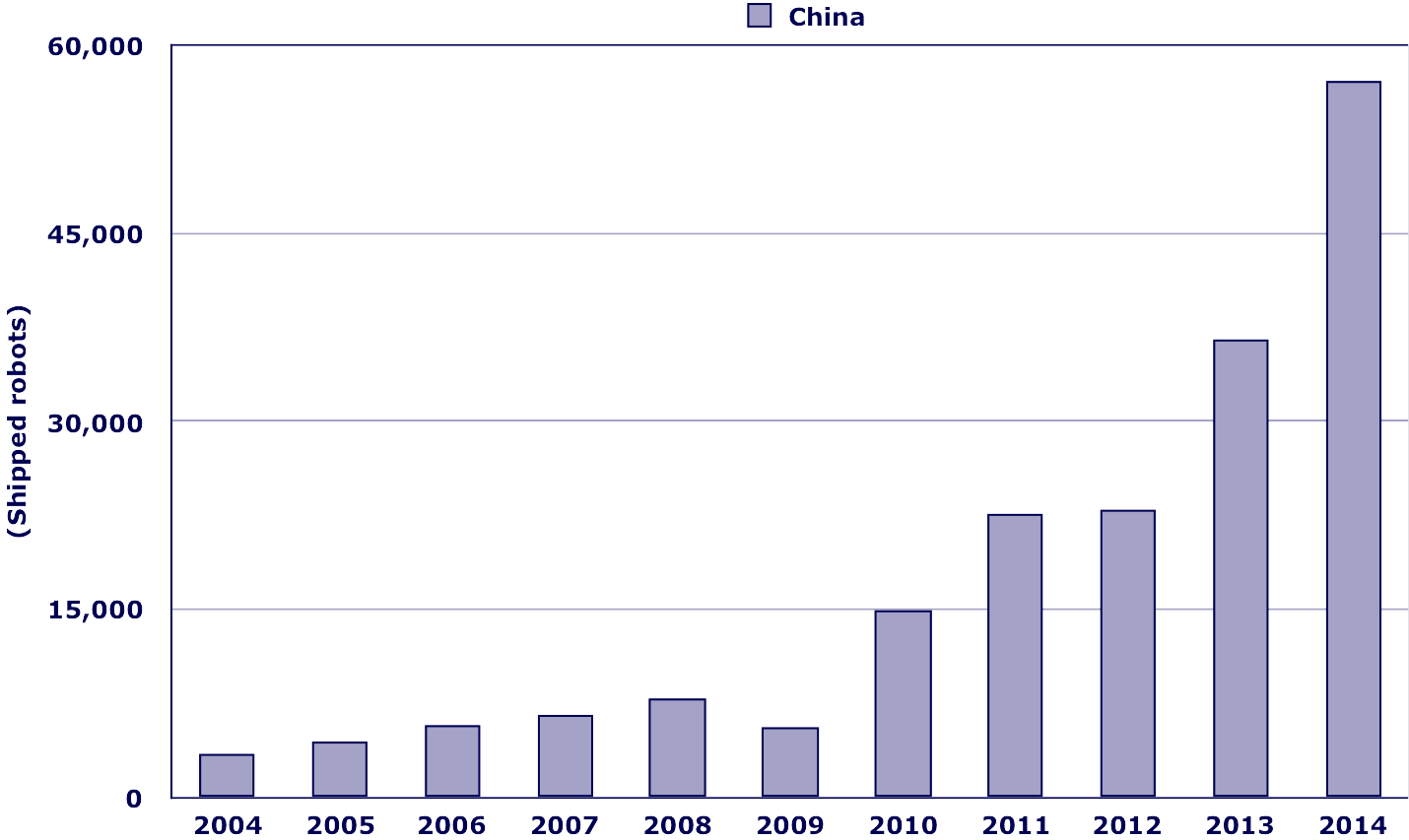
Over the last couple of years we have seen a major shift in industrial robot use worldwide. China, Japan and South Korea are responsible for 40% of all new robot Installation. China has more than 25% of all annual installations. The world market for robots grew 17% last year and has had a fairly steady growth since 2009. There are no indications that this growth will not continue for the next few years.

Robot shipping 2015

Shipping of robots worldwide over time [IFR World Robotics 2015]

It used to be that the biggest market for robotics was United States. By 2014 China took over as the single largest market. Over the last two years we have seen 50% annual growth in China in terms of new robot installation. China still has much below average installations of robots. The maturity of a market is typically compared by number of robots installed per 10,000 workers in the manufacturing industry. Mature industries, such as automotive, will typically have 1 robot for every 10 workers. South Korea has the most penetration of robots for manufacturing with 478 robots / 10,000 workers. Japan is #2 with 314 robots / 10,000 workers. Germany is at 292, USA is at 164. The world average is at 87 robots. China is at 36. Even with twice as many robots sold the country would still be below average is terms of use of robots. Even in automotive China is at 1 robot per 30 workers, and there is a lot of opportunity.

China robots 2015

Robot sales/shipping in China 2014. [IFR World Robotics 2015]

Why all the automation in China? 

An obvious answer would be that salaries in China have increased by 320% over the last decade. This is clearly challenging the economic feasibility of out sourcing from major industrialized countries such as USA, Germany, Italy, Japan, … No doubt this is a factor. 10 years ago a popular statement was “the world is flat”, i.e., shipping is cheap and as such products can be made anywhere. This is not necessarily true anymore.

However, a more important factor is product quality. In most cases automotive companies did not automate to reduce costs, but to build products that have a homogenous quality. China is slowly realizing that 7 days a week consistent quality is a key factor to international sales. To achieve this they need to have more robots for the plate shop, welding and paint operations. For electronics where tolerances are even more critical this is even more pronounced. Finally, China is trying to build a major aerospace industry where quality is second to none. All this points to continued major growth in robot use in China.

In the past many of the robots have been built outside of the country or through joint ventures by companies such as FANUC, ABB and KUKA. Even today close to 75% of all robots are built by the big robotics companies. However Chinese companies such as GSK, Siasun, etc. are slowing gaining on the market. The accuracy and average MTBF are improving to a level that make these products competitive at least in China.

No doubt the new generation of collaborative robots from UR, ABB, FANUC, etc are all going to be important for significant new growth in Asia. Through use of new technologies such as machine vision, machine learning, … we will see major new growth in robotics, but most of it will be in Asia at least for the short-term.

DARPA Student Video Contest

06 Friday Mar 2015

Posted by hichristensen in AMRON, robotics

≈ Leave a comment

Tags

robotics

DARPA LAUNCHES ROBOTS4US VIDEO CONTEST FOR HIGH SCHOOL STUDENTS

Winners Will Earn Opportunity to Attend DARPA Robotics Challenge, Discuss Future Implications of Robotics on Society

How will the growing use of robots change people’s lives and make a difference for society? How do teens want robots to make a difference in the future? As ever more capable robots evolve from the realm of science fiction to real-world devices, these questions are becoming increasingly important. And who better to address them than members of the generation that may be the first to fully co-exist with robots in the future? Through its new Robots4Us student video contest, DARPA is asking high school students to address these issues creatively by producing short videos about the robotics-related possibilities they foresee and the kind of robot-assisted society in which they would like to live.

Winners of the student video contest will attend, as DARPA’s guests, the DARPA Robotics Challenge (DRC) Finals, to be held in Pomona, Calif., June 5 and 6, 2015, at which teams of engineers from around the world will compete for $3 million in prize money as the robots they’ve created demonstrate their skills in the domain of disaster response. Student video contest winners will also get to participate in a special program in Pomona on June 7, which will bring together students and experts in technology and society to discuss the broader implications of a robotics-rich future.

“Today’s high school students are tomorrow’s technologists, policymakers, and robotics users. They are the people who will be most affected by the practical, ethical, and societal implications of the robotic technologies that are today being integrated into our homes, our businesses, and the military,” said Dr. Arati Prabhakar, DARPA director. “Now is the time to get them engaged and invested by encouraging them to ask questions and provide their views.”

U.S. high school students (grades 9-12) interested in participating in the contest are asked to submit a two- to three-minute video describing their vision for a future robot-assisted society. Videos should consider both current and anticipated advances in robotics technologies, and the implications of these advances for individuals, workplaces, and communities, as well as for national security.

Five winners, along with one parent or guardian each, will receive a trip to attend the DRC Finals, where they will watch some of the world’s most sophisticated robots respond to the kinds of challenges posed by natural and man-made disasters. Following the event, winners will take part in a special panel to discuss the ideas and views they featured in their videos. A “people’s choice” winner also will be selected based on public voting on videos that DARPA will post on YouTube in mid-April.

Submitted videos will be judged on the basis of clarity, creativity, thoughtfulness, originality, and appeal of the submitter’s vision of how robots could make a difference for society and the kind of robot-assisted society they would like to see—as well as the technical quality of the video. Videos by winners and other selected entrants will be featured on the DARPA website, YouTube channel, and other social media networks.

The contest begins on February 11, 2015, and entries from individuals or teams will be accepted through April 1, 2015. For more information and detailed rules and requirements, visit http://www.theroboticschallenge.org/Robots4Us.

Robot Growth

19 Thursday Jun 2014

Posted by hichristensen in robotics

≈ Leave a comment

Tags

iFR, ria, statistics

The IFR released their early results on robot sales for 2013 in association with the Automatica show in Munich. The numbers are highly encouraging. Worldwide sales went up to 179,000. This is an all-time high. The growth in Europe was modest, USA saw again solid two digit growth and Asia remains the biggest consumer of industrial robots. The major news here is the fact that China saw amazing growth with 37,000 units sold. The other major news is that 6,000 of the sold robots were manufactured in China. They have come a long way since the industry started a decade ago. The news clearly indicate that the single largest robotics market today is in China and it is seeing 40% annual growth. This, in combination with a very low penetration of the overall manufacturing sector, implies that we should expect to see continuing growth numbers for China. It is no surprise that KUKA recently has opened a factory in China, Universal Robots have opened a sales office, and ABB Robotics is headquartered in China. As salaries increase in China and cheap manufacturing is likely to go elsewhere it is only natural that China is trying to automate. The automotive sector is growing and the aerospace sector is also expected to see major growth as commercial airplanes from China are about to enter the market. It will be interesting to monitor the Chinese market as we see continued growth and major pushes by companies such as SIASUN.

← Older posts

Subscribe

  • Entries (RSS)
  • Comments (RSS)

Archives

  • January 2021
  • December 2020
  • September 2020
  • July 2020
  • June 2019
  • April 2019
  • December 2018
  • June 2018
  • December 2016
  • September 2016
  • August 2016
  • January 2016
  • March 2015
  • June 2014
  • September 2013
  • March 2013
  • January 2013
  • September 2012
  • November 2011
  • October 2011
  • September 2011
  • August 2011
  • July 2011
  • June 2011
  • May 2011
  • January 2011
  • January 2010
  • July 2009

Categories

  • AI/ML
  • AMRON
  • Conference/Meeting
  • robotics
  • Travel
  • Uncategorized

Meta

  • Create account
  • Log in

Blog at WordPress.com.

  • Subscribe Subscribed
    • Henrik Christensen's Blog
    • Already have a WordPress.com account? Log in now.
    • Henrik Christensen's Blog
    • Subscribe Subscribed
    • Sign up
    • Log in
    • Report this content
    • View site in Reader
    • Manage subscriptions
    • Collapse this bar
 

Loading Comments...